
Human Factors / Ergonomics (HFE)
In my professional life, I worked as both a Research Psychologist (CPsychol, AFBPsS) and also a Human Factors Specialist (CErgHF). Here are a few figures that I constructed to illustrate aspects of that somewhat niche, frequently misunderstood scientific discipline. A selection of my publications can be found on ResearchGate if of any interest.
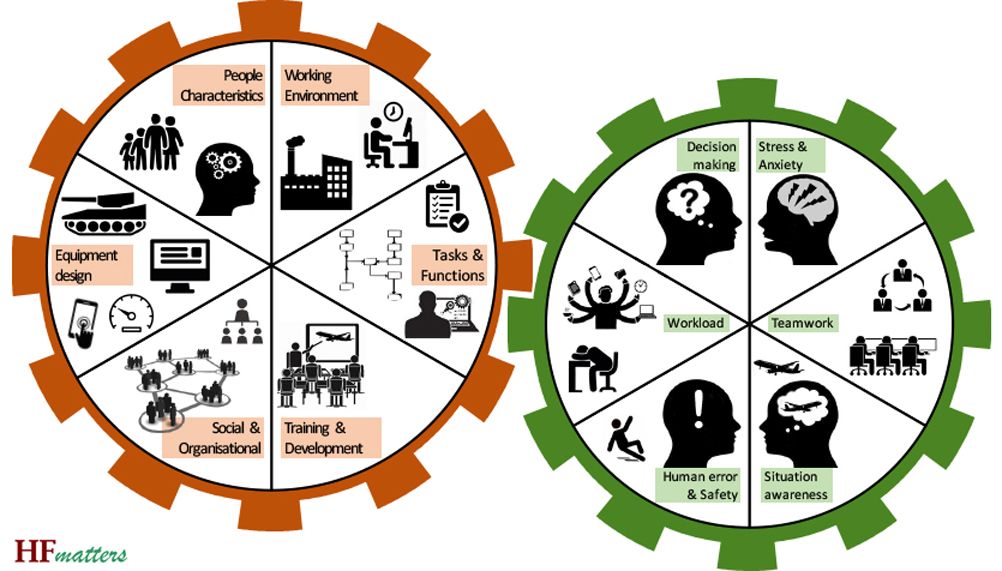
Scope of Human Factors
Diagrammatic illustration of the scope of Human Factors. The left-hand 'cog' shows the 6 main technical areas:
- People Characteristics
- Equipment Design
- Working Environment
- Tasks & Functions
- Social & Organisational; and
- Training & Development.
The right-hand cog shows the 6 main factors of human performance.
Acknowledgement The diagram is a variation of the EUROCONTROL Human Factors 'Gearbox' (circa 2008), which distinguished six System level factors interacting with six Human Performance level factors. That Gearbox was itself based on an earlier Human Factors 'Pie' diagram (circa 2002).
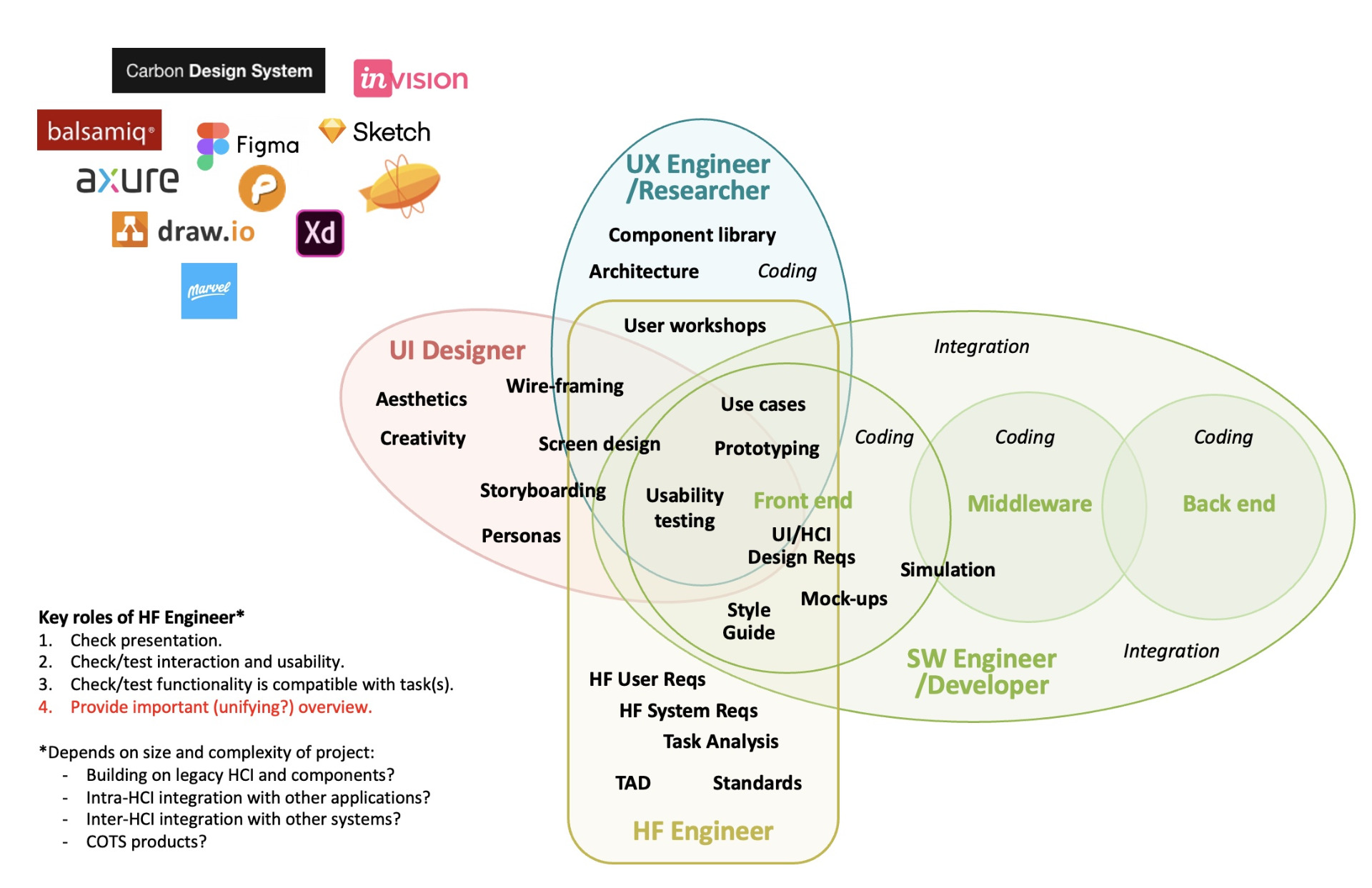
Human Factors and UX
Diagrammatic illustration of the meaning of User Experience (UX) viewed from the perspectives of four engineering professions:
- Human Factors (HF) Engineer
- User Interface (UI) Designer
- UX Engineer / Researcher
- Software (SW) Engineer / Developer
As can be seen, there are considerable overlaps between the four, and hence the confusion in understanding or distinguishing between their respective areas of concern. Hence also the reason why UX professionals are sometimes said to be taking over HF or at least encroaching on what HF has traditionally regarded as its domain.
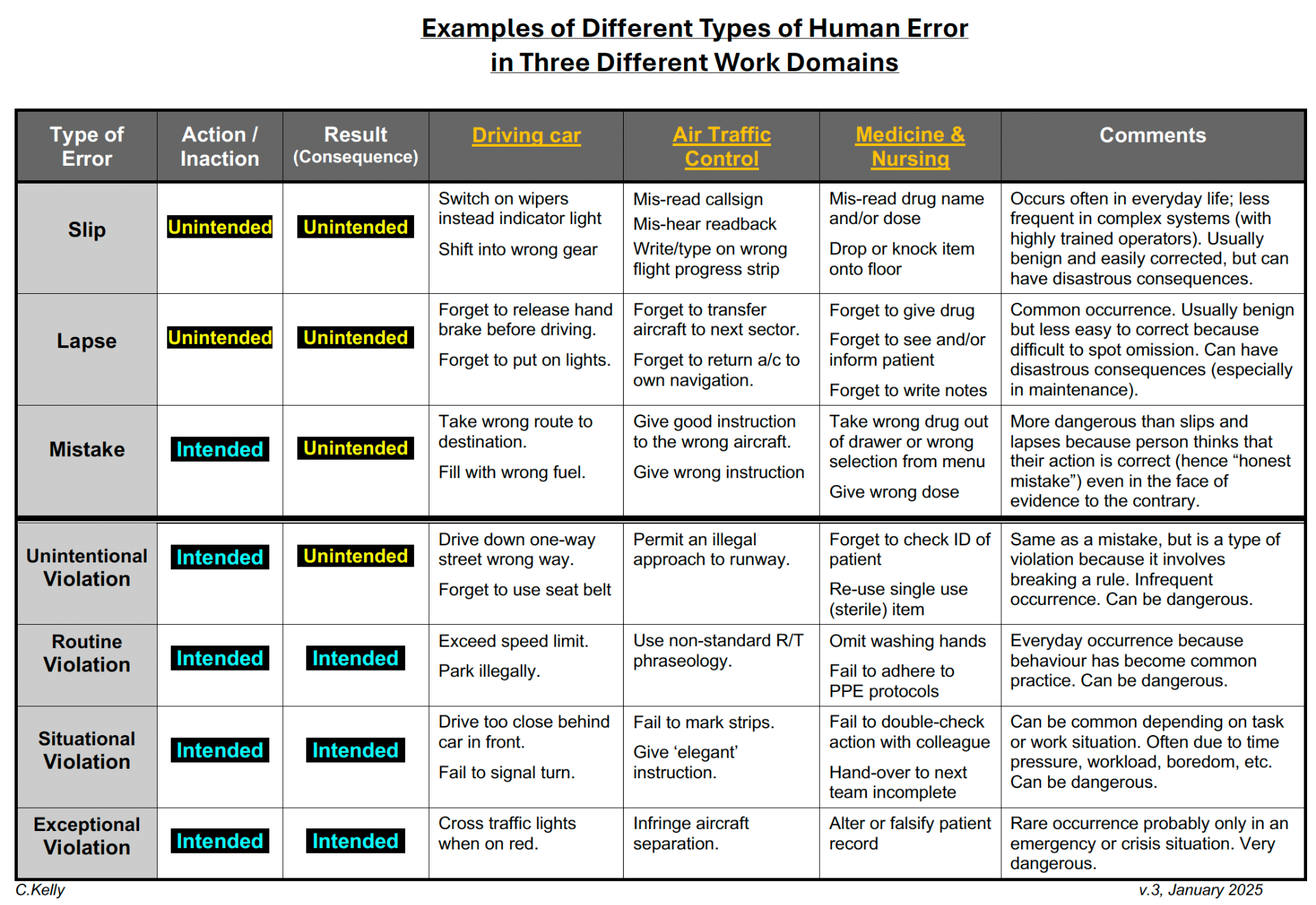
Human Error
The saying "to err is human" is well known and the term 'human error' perhaps gives the impression that it covers all unsafe acts. However, human error is the result of a mixture of factors. As Professor Reason wrote, human errors take many different forms, have different psychological origins, and require different methods of management. The types of human error that are typically distinguished (but not everyone agrees) are: slips, lapses, mistakes and violations .
I produced the first version of the table opposite in the late 1990s, while working at DERA. I was the lead researcher on a "Proposal to develop a concept and taxonomy for human error in ATM" (submitted to EUROCONTROL). The proposal was unsuccessful, but I did usefully cross paths with Professors Neville Moray and Patrick Hudson who were part of our project team. I vaguely recall that I constructed the table based on something Prof. Hudson had written, which I then elaborated with the 'work domain' examples, but it's a long time ago!
Ps. The research output from the team that won the EUROCONTROL project was called HERA.